Differing Site Conditions Claim: Who Carries the Cost?
On a federal fixed-price construction contract, the cost of a site that does not match the contract documents sits with the government, provided the condition qualifies under the Differing Site Conditions clause and the contractor gave written notice before disturbing it. The clause is FAR 52.236-2, and FAR 36.502 requires it in fixed-price construction contracts expected to exceed the simplified acquisition threshold. Below that threshold the contracting officer may include it. Where it applies, the answer to "who pays" is written down before anyone breaks ground, which is the point of having it.
Updated November 2026.
The rest of this is about the two conditions the clause recognizes, what the file needs, and the one sentence in the companion clause that cuts the other way.
The two kinds of condition
The clause names two, and boards and courts call them Type 1 and Type 2.
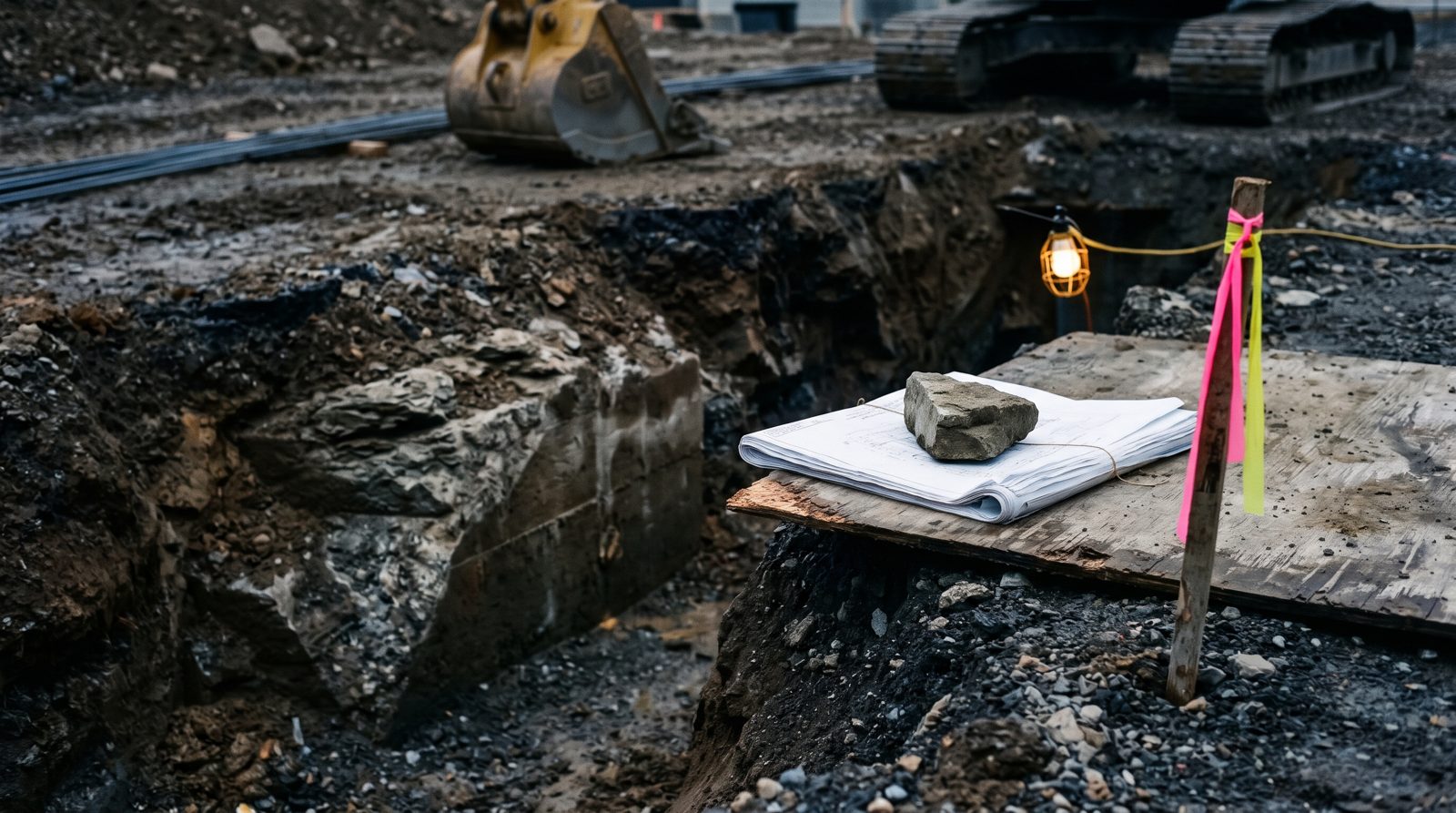
A Type 1 condition is a subsurface or latent physical condition that differs materially from what the contract indicated. The drawings show sand and the excavation hits ledge. The boring logs show groundwater at a depth the trench never reaches, and the trench floods. The test is the contract itself: what did the documents, read as a whole, lead a bidder to expect.
A Type 2 condition is an unknown physical condition of an unusual nature, one that differs materially from what is ordinarily encountered in work of that character. Nothing in the contract has to say anything about it. The bar is higher, because the contractor has to show the condition was unusual for that kind of work, and that is a harder argument to win than pointing at a boring log.
Most of the disputes we see described are Type 1, for a simple reason. The government drew something, and the site disagreed.
Notice comes first, and it has a sequence
Paragraph (a) of the clause asks for written notice to the contracting officer promptly, and before the conditions are disturbed. Both halves matter. "Promptly" keeps the record fresh. "Before the conditions are disturbed" lets the government see what was found while it is still there to see.
Paragraph (b) then puts the next move on the contracting officer, who has to investigate promptly. If the condition does materially differ and changes the cost or the time of any part of the work, an equitable adjustment is made and the contract is modified in writing.
Paragraph (c) is the one that loses claims. No adjustment is allowed unless the written notice was given, though the contracting officer may extend the time for giving it. Paragraph (d) closes the door entirely once final payment is made.
So the order on site is: stop disturbing the area, notify in writing, let the government look, then price. We would put that sequence in front of every superintendent on a federal job before the first excavation, because a crew that digs through a surprise to keep the schedule has just made the condition impossible to verify.
The clause runs both ways
This gets overlooked. Paragraph (b) speaks of an increase or a decrease in cost or time. If the site turns out easier than the contract indicated, the adjustment can go down. A contracting officer reading the clause only as a contractor's remedy is reading half of it.
What the companion clause takes away
FAR 52.236-3, Site Investigation and Conditions Affecting the Work, usually sits in the same contract. In it the contractor acknowledges that it took the steps reasonably necessary to understand the site, and that it satisfied itself as to surface and subsurface conditions so far as they were reasonably ascertainable from an inspection of the site, the government's exploratory work, and the drawings and specifications.
That sentence is the government's defense to a weak claim. A condition a reasonable site visit would have revealed is not a differing site condition, however surprised the bidder was. Paragraph (b) of the same clause adds that the government takes no responsibility for the contractor's own conclusions or interpretations drawn from information it provided.
The practical reading for both sides: the clause covers what the documents and a reasonable inspection could not show. It does not cover a bid that skipped the site visit.
What the file needs afterwards
If the claim is ever reviewed, the file has to show the condition, the contract indication it differed from, and the timing. In practice that means the written notice with its date, photographs taken before the area was disturbed, the contract drawings or boring logs the condition is measured against, the contracting officer's investigation, and a cost and time impact tied to the affected work, ending in a written modification. Our earlier piece on what happens after contract award covers the submittal and documentation rhythm this sits inside.
Why this is our kind of problem
Much of our published work is the type where conditions are found rather than drawn. We built a new bath house with an entirely new septic field and system at Hacklebarney State Park for the NJDEP. We are delivering modernization of an active maintenance hangar, Building 1001, for the Air National Guard, and an expansion and renovation for new MRI suites at the Providence VA Medical Center. Existing structures and ground work carry more unknowns than a greenfield slab, and the same is true of construction inside a facility that cannot close.
Our view, for owners: the cheapest protection is better information in the solicitation. Borings, existing-conditions surveys and as-built records that bidders can rely on narrow the gap between what was drawn and what is there, and every bidder prices the same site. State and local owners in New Jersey write their own general conditions, so read the clause in that contract rather than assuming the federal one applies.
Agencies scoping work on an existing structure or a disturbed site can request our capability statement or contact us to prequalify. Our general construction and electrical capabilities set out what we self-perform in New Jersey.
Citations verified at primary sources on 2026-11-16: FAR 36.502, FAR 52.236-2 (Apr 1984) and FAR 52.236-3 (Apr 1984), acquisition.gov, FAC 2026-01.