
Building Around the Occupants: Construction Inside a Facility That Cannot Close
Working in an occupied facility means the building's mission, not the construction schedule, sets the order of work. A hospital wing keeps admitting, a school keeps holding classes, a federal facility keeps running its access control, and the contractor phases around all of it. That constraint belongs in the solicitation as scope, not in a preconstruction meeting as a hope. We deliver this way on VA, federal, K-12 and municipal projects, and the terms below are the ones we ask owners to write in rather than negotiate on site.
Reviewed and updated September 2026.
Imperial Construction & Electric is a certified MBE/SBE contractor with more than 20 years of public-sector delivery and over 200 completed projects for the Department of Veterans Affairs, federal agencies, and K-12 and municipal owners across New Jersey and the Northeast, under both design-build and design-bid-build. Our existing posts cover the sequence that runs after a contract award and the documentation deliverables federal work carries. This one covers the condition most of that work actually happens in: a building that cannot close.
What Changes When the Building Keeps Running
More than the schedule.
On a vacant site, sequence is driven by trade logic and weather. In an occupied facility it is driven by the occupant: when the wing is empty, when the corridor has to stay clear, when a shutdown is permitted, when noise is tolerable and when it is not. The construction logic still applies, but it runs second.
The practical effect is that productive hours shrink and mobilizations multiply. A crew that would run a continuous 10 hour day on an open site may get a 5 hour window, and the same scope gets rebuilt into more, smaller phases with a setup and a teardown around each. An owner comparing two bids where one priced continuous access and one priced the real window is not comparing the same job.
Phasing Belongs in the Scope
The single most useful thing a solicitation can do is define the phasing constraint rather than leave it to the contractor to discover.
Name the areas that have to stay in service and when. Name the permitted shutdown windows for each utility and system. Name the maximum area that may be out of service at once. State whether swing space exists, and if it does, who prepares it and at whose cost.
When those are in the scope, every bidder prices the same constraint and the spread between bids means something. When they are not, the low bid is usually the one that assumed the most access, and the difference comes back as a change order once the first phase collides with the occupant's calendar.
Access Control, Badging and Escort
This is where occupied-facility work diverges most sharply from commercial work, and it is routinely underpriced.
A federal or healthcare facility may require background screening and badging for every worker on site, and the lead time on that is not trivial. Some areas require an escort, meaning a facility staff member accompanies the crew, so the work can only proceed when that person is available. Some require sign-in and sign-out at a controlled point, key or credential control for the duration, and re-badging for anyone who rotates onto the job.
Three questions belong in the solicitation, because each carries cost:
- Who pays for screening and badging, and what is the turnaround?
- Where escort is required, is the escort provided by the facility or billed to the contract?
- What happens to the schedule when a badge is delayed or an escort is unavailable?
A bidder who has done this work will have answers. A bidder who has not will price the labor and miss the access.
Containment and the Systems That Cannot Be Interrupted
Containment is a life-safety and mission-continuity deliverable, not housekeeping.
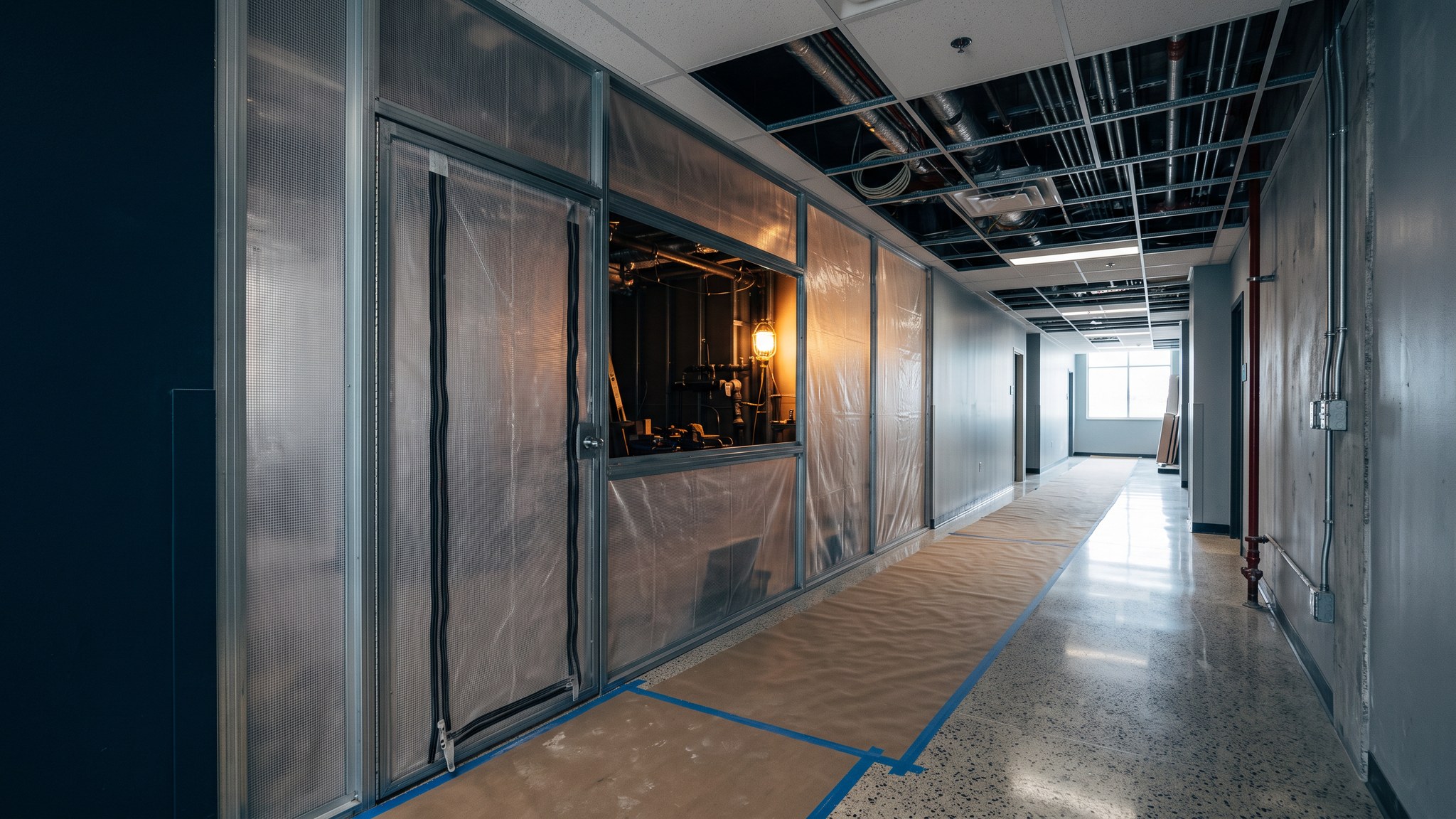
On healthcare and VA work, an infection control risk assessment governs it: negative-pressure enclosures, sealed and gasketed partitions, HEPA filtration, tacky mats, defined routes for debris removal that do not cross patient areas. On K-12 work, the equivalent constraints are dust, noise and odor during instructional hours, plus scheduling anything with fumes into breaks. On a data-bearing or operational facility, the constraint is the systems themselves.
The interruption question is the one to settle first. Fire alarm and sprinkler coverage, emergency power, medical gas, data, and normal power to occupied areas each need a stated rule: whether it may be interrupted at all, under what notice, with what temporary provision, and who approves the outage. Fire watch requirements during any impairment should be named, along with who provides it.
Written that way, containment is inspectable. Written as "contractor shall minimize disruption," it is an argument waiting to happen.
Crew Conduct as a Contract Term
Inside an occupied building the crew is a visitor in someone else's workplace, and conduct is a contract matter rather than an expectation.
Put the boundary in writing: the defined path from the site entrance to the work area, which restrooms and break areas are the contractor's, where vehicles park and stage, whether photography is permitted, and the rule on interacting with occupants, which in healthcare and school settings is generally that crews do not. Radios, music and audible language carry further in a quiet corridor than anyone expects.
Name the enforcement mechanism too, meaning who the owner calls and what the contractor is obligated to do about it. An owner who has to improvise a response to a conduct problem mid-project has already lost time. The reason this belongs in the contract and not in a briefing is that a briefing binds nobody after the first crew rotation.
Egress, Life Safety and Inspections Do Not Pause
The building's occupancy requirements stay in force for the whole job.
Required exits stay open and marked, or an approved temporary route is established and posted before the original is touched. Corridor clear width is maintained. Temporary construction cannot reduce the exit capacity the occupancy was approved for, and anything that does requires an approved plan first, not a retroactive explanation.
Authorities having jurisdiction inspect on their own calendar. So does the owner's safety staff, and on federal work the quality control regime runs continuously against the contract rather than at milestones. A phasing plan that only works if no inspection happens during a given week is not a plan.
What to Ask a Bidder to Describe
For a contracting officer or facility manager evaluating proposals, the most revealing prompt is not about speed.
Ask a bidder to describe how they phase work around an occupant, not just how fast they can build. Then ask for:
- A phasing narrative tied to the facility's actual operating calendar, not a generic Gantt chart.
- Named past performance in an occupied facility of similar type, with the occupant's constraint described.
- Their containment approach for this building's specific risk, and who on their staff owns it.
- How they handle badging and escort lead time, stated as a schedule assumption.
- The superintendent who will run this, and whether that person has done occupied work before.
The answers separate contractors who have built in a running facility from contractors who have built well in an empty one. Both are legitimate. Only one of them is what an occupied renovation needs.
Imperial self-performs both general construction and electrical in New Jersey, which on occupied projects removes a coordination layer at exactly the point where shutdowns and re-energization have to be sequenced against the occupant's calendar.
To review our occupied-facility past performance for a specific solicitation, contact us to prequalify or request our capability statement. Our capabilities and project history pages carry the rest.