
Self-Perform vs Subcontract: Electrical on NJ Public Work
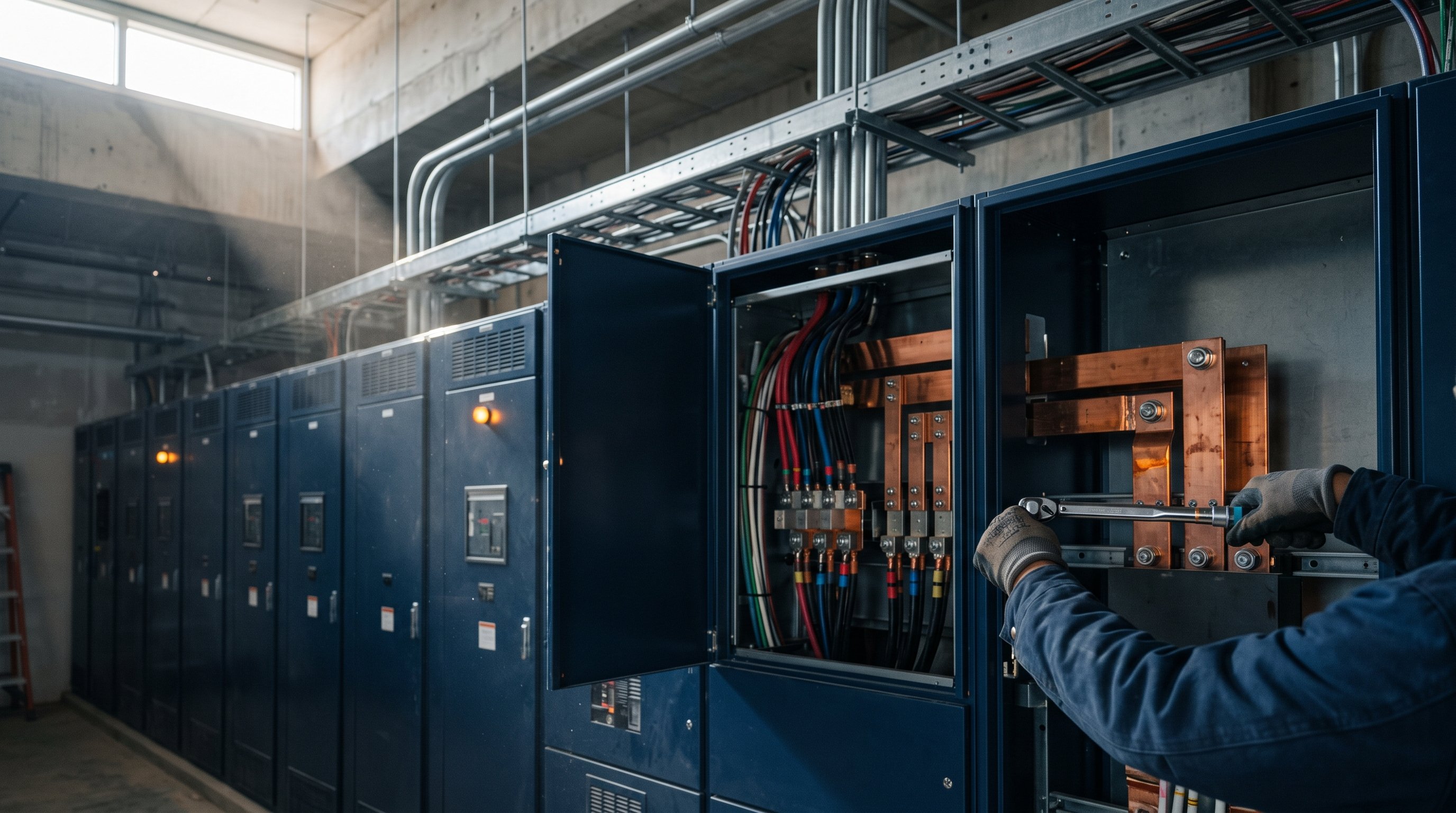
Ask every bidder which scopes its own employees will install and which it will subcontract, and ask the question state by state, because the answer can change at a state line. Ours does. On public work in New Jersey we are a self-performing electrical contractor: our own crews install the electrical scope, under our license as a New Jersey Electrical Contractor. Outside New Jersey, the electrical on our projects is performed by qualified subcontractors, licensed in the state where the work is performed, under our general construction management.
Updated September 2026.
Imperial Construction & Electric is a certified MBE/SBE general contractor with more than 20 years of public work behind it, for the Department of Veterans Affairs, the Department of Defense, federal agencies, K-12 and higher-education owners, and state, county and municipal clients across New Jersey and the Northeast. We're writing this for the contracting officer or facility manager holding three bids with three different staffing stories, since the price on a bid form says nothing about whose people will be in your building.
What Self-Perform Means
Self-performed work is work installed by the prime contractor's own employees, on its own payroll, under its own license. That's the entire definition. It's narrower than the way the word gets used in interviews, where a firm that supervises a trade, or has used the same electrical sub for a decade, will sometimes describe the result as its own work.
Supervising a trade is a real service. We sell it ourselves, as construction management anywhere from a fee basis to a guaranteed maximum price. Managing electrical work and holding it are still different jobs, and the difference decides three things you'll care about later: whose people are on your site, whose foreman answers when something goes wrong, and who can move when your schedule moves.
On New Jersey Public Work, the Bid Form Already Asks
New Jersey writes part of this question into its bidding statutes. When a public building contract above the bid threshold is bid as a single overall contract, the bid has to name the subcontractors the bidder will use for four branches of work: plumbing and gas fitting, heating and ventilating, electrical, and structural steel and ornamental iron. Subcontractors doing general construction are not named. The requirement sits in the Local Public Contracts Law (N.J.S.A. 40A:11-16), the Public School Contracts Law (N.J.S.A. 18A:18A-18), the state and county college contracting laws, and the statute governing the State's own buildings (N.J.S.A. 52:32-2).
So read the electrical line before you read the number. If a firm is named there, that firm is who you are actually buying for the electrical branch, and it has to be qualified in its own right. Our note on what to confirm about a bidder before bid day covers how to check that standing. If no electrical subcontractor is named, either the bidder is telling you its own forces will perform that branch, or the bid has a problem you want to find before award. Get the answer in writing, along with the license and classification that cover it. On our New Jersey bids, that confirmation is the answer, because the electrical is ours.
Federal Work Dropped Its Floor in 2025
For decades, federal construction contracts carried a clause, FAR 52.236-1, requiring the prime to perform a minimum share of the work with its own organization, ordinarily at least 12 percent. The 2025 Revolutionary FAR Overhaul drops it. GSA's class deviation for FAR Part 36, dated July 22, 2025, deletes both the policy at 36.501 and the clause, and agencies have been adopting the overhaul through deviations of their own. Whether a particular solicitation still sets a self-performance percentage now depends on the agency and the solicitation, so check the one in front of you rather than assuming the old number.
Set-asides still carry a limit. On a small-business set-aside above the simplified acquisition threshold, or a contract under one of SBA's socioeconomic programs, the limitation on subcontracting applies: a general construction prime may not pay more than 85 percent of what the government pays it to firms that are not similarly situated, and a special trade contractor no more than 75 percent, with the cost of materials excluded (13 CFR 125.6). On unrestricted work at an agency that has adopted the deviation, the contract may set no self-performance minimum at all. That can be a perfectly good plan. You'd still want to know it before award, not at the first missed outage.
Where It Shows Up on the Job
Self-performance rarely changes the baseline schedule. It shows up when the baseline breaks.
Schedule recovery is the first place you see it. Occupied public buildings move their shutdown windows all the time, and when a Saturday outage slides two weeks, a contractor that holds the trade re-sequences its own crew. A broker calls a subcontractor who may have promised that Saturday to someone else.
Coordination is the second. Electrical touches nearly every other scope in a renovation: power and controls for the mechanical equipment, fire alarm connections to sprinkler flow and tamper switches, elevator recall, air handlers that shut down on alarm. With the electrical in house, those handoffs get settled inside one company instead of across three contracts.
The third is the one owners remember. When an electrical inspection or a fire alarm acceptance test fails, someone has to be standing there who can say what went wrong and fix it that week. On our New Jersey work, that person is our foreman. That's the practical difference, as we see it, between a firm that manages a trade and a firm that holds it.
What a Subcontracted Scope Gets Right
None of this makes a subcontract-heavy bid a bad one. A general contractor that subcontracts every trade can bring in specialists it would never keep on staff, and it can take work in states where it holds no trade license of its own. We work that way ourselves outside New Jersey, and we'd defend it: our electrical there is performed by qualified subcontractors licensed in the state of performance, under our management. We name them in the proposal rather than after award, so the owner can check who is doing each scope before anything is signed.
What goes wrong is an owner who believes it bought one model and finds out mid-job that it bought the other.
What to Ask Every Bidder
Put these to each firm on the shortlist, in writing, and ask for the answer by state if the work crosses one:
- Which scopes will your own employees perform, on your payroll and under your license?
- For each scope you subcontract, which firm is it, is it named in the proposal, and is it licensed and classified where this building sits?
- Who is the foreman on each self-performed scope, and who from your side attends the inspections?
- If a shutdown window moves, whose crew re-sequences, and how quickly?
Our answer to the first question is electrical, in New Jersey only. The electrical scopes we self-perform in New Jersey (switchgear, medium voltage services, substations and fire alarm controls among them) are listed on our services page, and our certifications, DPMC classification and SDA prequalification are posted on our About Us page. To see how we would staff a specific solicitation scope by scope, contact us to prequalify or request our capability statement.