
As-Built Drawings at Project Closeout: The Owner Check
Verifying as-built drawings at project closeout means one specific check: set the marked record drawings next to the executed change-order log and confirm every approved change actually shows up on the set the owner will keep. On most public contracts the owner is holding 5% retainage against exactly this deliverable, and final payment does not release until the record set, the operations manuals, and the warranties are accepted. That is the whole point of the check. We deliver this package on our federal and K-12 projects, and the procedure below is the one we ask owners to require rather than negotiate at the end.
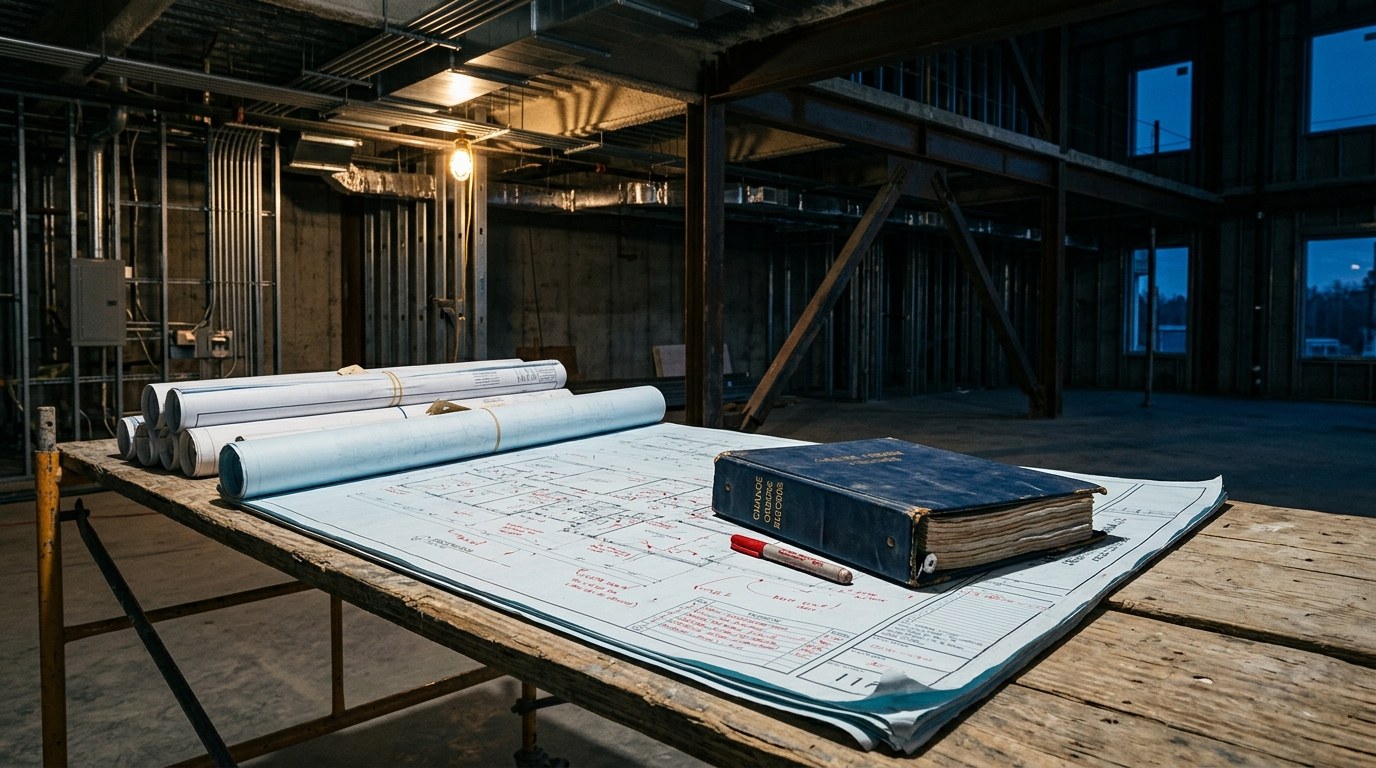
Reviewed and updated September 2026.
Imperial Construction & Electric is a certified MBE/SBE prime contractor with more than 20 years of public-sector delivery and over 200 completed projects for the Department of Veterans Affairs, federal agencies, and K-12 and municipal owners across New Jersey and the Northeast, under both design-build and design-bid-build. Our existing posts cover the deliverables during the work and the sequence that runs after a contract award. This one covers the end of the job, where a record set either matches the building or quietly does not.
What a Record Drawing Is Supposed to Show, and Who Marks It
A record drawing, the as-built, is the contract drawing corrected to reflect what was installed: conduit that shifted to clear a beam, a duct resized in the field, a valve moved 2 feet, a branch circuit rerouted around a condition nobody saw until the wall was open. It is the drawing the owner's facilities staff will pull in five years to find a shutoff behind drywall. If it lies, they cut the wrong wall.
Who marks it matters as much as what it shows. Field crews redline as they build, in near real time, because a change marked three months later is a change reconstructed from memory. The quality control manager or a CAD technician then incorporates those redlines into a clean record set. On design-build the design entity updates its model directly. The failure mode is always the same: redlines that live on a rolled-up print in a job trailer and never make it into the set the owner receives.
Reconciling the Change-Order Log Against the Marked Set
The core closeout check is a reconciliation, not a glance. Take the executed change-order log, and for each change order confirm the drawings it touched carry a corresponding markup. Then do the same for two other sources of physical change that never open a change order on their own: RFIs that altered the installed work, and field directives issued to keep the job moving before the paperwork caught up. Three streams feed the record set, and only one of them is the CO log.
A change order that moved a transformer pad but left the site electrical plan untouched is not a paperwork gap. It is a building the owner cannot maintain from its own drawings. Run the reconciliation line by line: change-order number, the sheets it should have revised, and a confirmed markup on each of those sheets. Where a number has no drawing behind it, the record set is incomplete, and that is the finding to raise before substantial completion, not after final payment has gone out.
Where Field Changes Disappear Most Often
Some scopes swallow field changes more than others. Underground and concealed utilities top the list, because the evidence is buried by the time anyone asks. Electrical rough-in inside walls and above-ceiling mechanical routing come next, since both are covered by finishes long before closeout. Anything installed under a field directive ahead of a formal change order is the fourth trap, because the physical work exists while the drawing revision is still in someone's inbox.
This is where our structure helps the owner. Because we self-perform electrical as a licensed New Jersey electrical contractor, the electrical as-builts are marked by the same crews that pulled the wire, not reconstructed at closeout from a subcontractor's recollection. That is one trade the owner does not have to take on faith.
| Scope | Where the change hides | What to verify at closeout |
|---|---|---|
| Underground utilities | Buried before survey | Marked invert, routing, and tie-in against the field survey |
| Electrical rough-in | Inside finished walls | Circuit and device changes redlined by the installing crew |
| Above-ceiling MEP | Covered by ceilings | Rerouted duct, pipe, and conduit against the coordination set |
| Field-directed work | Done ahead of the CO | A drawing revision tied to every directive and RFI |
The Rest of the Closeout Package
Record drawings are the piece owners scrutinize, but they arrive with a package. Operations and maintenance manuals, equipment cut sheets, warranty certificates, attic stock and spare parts, testing and commissioning reports, and the signed closeout checklist all land together. On most public work the correction period runs one year from substantial completion, and the warranties have to name dates the owner can enforce against, not the day the box was delivered. A record set that matches the building and a warranty that starts on the right date are what keep a punch-list dispute from becoming a payment dispute. We assemble the full package as a single deliverable, indexed, so a reviewer is checking a set rather than chasing loose paper.
What Substantial Completion, Punch, and Final Payment Each Release
Three milestones close a job, and each one releases something different. Substantial completion is the point the owner can occupy and use the facility for its intended purpose; it typically starts the warranty clock, shifts responsibility for the building, and on many contracts releases part of the retainage. The punch list is the remaining corrective work, generated at that same walk-through and closed item by item. Final completion and final payment come last, and they release the balance of retainage only after the punch is done and the closeout documents, record drawings included, are accepted. An owner who signs substantial completion without the as-builts in hand has given up most of the pressure that gets the record set finished.
What an Owner Should Require in the Spec
The cleanest way to avoid a closeout fight is to write the requirement into the specification, so the record set is a contract obligation rather than a favor asked at the end. Name the record-drawing standard and the format the owner will accept, whether that is redlined PDFs or an updated CAD or model file. Require that markups stay current and be verified against each monthly pay application, so the record set builds as the job builds. State plainly that accepted as-builts are a condition of final payment, and reconciled against the change-order log before that payment is certified. That single clause turns the check described here from a negotiation into a deliverable.
Public owners and prime GCs evaluating a subcontractor can request our capability statement or review how we handle documentation as a scored contract deliverable across the full scope of our work. We would rather tell you up front what our closeout package contains than leave you verifying it after the retainage is gone.